Ear Necrosis in Pigs: How Infection, Tissue Damage, and Biting Interact
Controlled research clarifies the infectious component of swine ear necrosis while showing why behavior, tissue damage, and field conditions still matter.
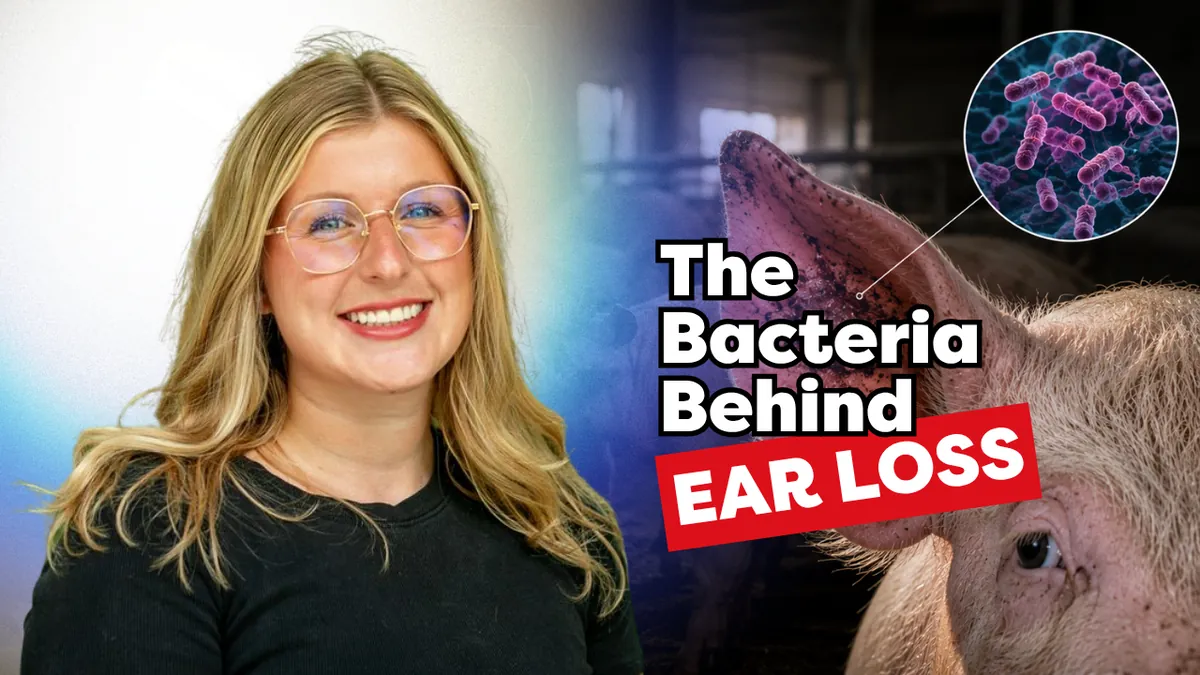
Ear necrosis is easy to recognize once tissue begins to darken or disappear, but the biology behind the lesion is more complicated than its appearance suggests. Evidence from controlled challenge work supports an infectious component, while observations of biting, exposed tissue, and pen-level behavior point to a broader process in which bacteria, injury, and social interaction can reinforce one another.
This distinction matters for prevention. Finding a bacterium does not mean that every case follows one simple pathway or that one treatment will solve the problem. A useful response starts by separating what has been demonstrated experimentally from what remains under investigation.
An Infectious Component Has Been Reproduced Experimentally
Controlled challenge work has shown that Fusobacterium necrophorum can produce lesions resembling porcine ear necrosis. In the study, Staphylococcus hyicus did not produce lesions, while F. necrophorum reproduced lesions similar to those observed under farm conditions.
The model demonstrates that F. necrophorum can reproduce PEN-like lesions under controlled conditions, but it does not establish that the organism is the sole cause of every field case or prove the natural route of infection on farms. Field findings point to complex microbial involvement rather than one organism being consistently responsible across all cases. Ear biting and other oral manipulation may contribute by damaging tissue or introducing microorganisms, but they should be treated as associated factors and plausible mechanisms, not as a universal causal sequence.
Anaerobic Growth Complicates Detection and Research
F. necrophorum is anaerobic, so recovery and culture may be sensitive to sample collection, transport, oxygen exposure, laboratory methods, and organism viability. A negative culture result should therefore be interpreted alongside sampling conditions, lesion characteristics, and other diagnostic findings rather than used alone to confirm or exclude involvement.
The Challenge Model Clarifies Local Lesion Progression
In the experimental F. necrophorum challenge model, local inflammation and edema progressed to tissue damage, necrosis, tissue separation, and subsequent healing. This sequence describes the controlled model and should not be treated as a fixed clinical course for commercial farms.
In that experimental model, early changes were concentrated in the dermis, with marked swelling and edema. The findings help characterize local tissue involvement after direct challenge, but the precise mechanisms remain unresolved, and histological patterns in natural field cases may differ.
Farm cases may progress differently when biting pressure, existing damage, age, environment, microbial communities, and concurrent health challenges vary.
Welfare Risk Extends Beyond the Missing Tissue
Observed behaviors in challenged pigs included ear shaking and rubbing against pens or walls, consistent with pain or irritation associated with the lesions. As necrotic tissue detaches, fresh tissue and blood can become exposed. Those changes may attract additional chewing by pen mates and contribute to further damage.
In the challenge work described, systemic illness was not a prominent finding. A major welfare concern in the challenge model was local pain combined with social and behavioral consequences. This observation should remain limited to that model because field cases can develop secondary complications. Pen observation therefore matters, and severity cannot be evaluated only by checking whether pigs appear systemically ill.
Porcine ear necrosis is most often associated with weaned and nursery pigs and can extend into the early grower period. Post-weaning social interactions, oral manipulation, and mixing may contribute because damaging contact can increase during that stage. Cases in older animals also occur, but they should not be treated as the primary epidemiological pattern.
Management Should Match the Current Evidence
Evidence for specific treatments remains limited, and antimicrobials should not be presented as a universal solution. They may still have a role in severely affected animals when clinical and bacteriological findings support their use under veterinary direction. If one pig is repeatedly targeting an affected pen mate, separation may reduce continued chewing. However, separation should not be interpreted as proof that bacterial exposure has been contained.
Enrichment, stocking conditions, grouping, sanitation, and the physical environment are relevant because they can influence oral manipulation, tissue trauma, and exposure conditions. However, a direct reduction in ear necrosis through any single management intervention has not yet been established. Prevention and control should include efforts to reduce damaging behavior and trauma, improve relevant husbandry conditions, and investigate infectious and environmental contributors.
A proportionate farm response is therefore to document when lesions begin, identify whether biting precedes or follows visible damage, watch for repeat aggressors, assess grouping and environmental conditions, and work with the herd veterinarian on sampling and case management. This approach preserves the distinction between supported observations and interventions that still require validation.
A Multifactorial Problem Requires Better Field Data
Variation in lesion severity across farms reinforces the need to avoid a single-cause interpretation. The next advances depend on combining controlled models with field epidemiology. Longitudinal observation could show how age, mixing, oral manipulation, lesion onset, microbial findings, and environmental conditions align. Management and treatment strategies could then be evaluated against defined outcomes rather than assumptions.
Current evidence indicates that F. necrophorum can produce characteristic lesions in an experimental challenge model, while natural transmission, the contribution of other organisms, lesion severity, and practical control remain shaped by unresolved biological, environmental, and behavioral factors. Management decisions should reflect both the strength and the limits of that evidence.
Listen to The Swine it Podcast Show Canada, Episode 182, “Alison Jeffery: Understanding Ear Necrosis,” for the complete discussion: https://episodes.wisenetix.com/blog/understanding-ear-necrosis?utm_source=article-post